
- Home
- International Programme
- Publications
- Colloquiums
- Seminars
- Blog
- IJATM
- Young Author Prize
The merits of Super Mario's dissonant music
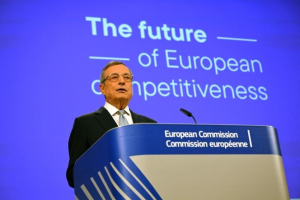
The weekly column by Bernard Jullien Former director of Gerpisa, associated professor at the University of Bordeaux.
No one knows what fate Parliament, the Council and the Commissions will ultimately reserve for the bold proposals contained in the Draghi report, which was presented to Ursula von der Leyen on September 9. Nevertheless, with the credibility conferred on him by the success of the policy he has pursued at the ECB, it is difficult to sweep aside the 400 pages of his report and his theses with the stroke of a pen. In the face of players and observers who scoff at the inadequacies of European policies compared to those of China or the United States, which are much bolder and more costly, he has come to say that the need to be met is first and foremost a need for massive investment, and that meeting this need means breaking free from the budgetary constraints that some people too readily present as absolute.
After reading the report that justified protectionist measures, reading the Draghi report should not disarm us: the first justifies the need to limit the effects of a highly offensive policy by erecting “compensatory” customs barriers commensurate with the aids and subsidies that boost the competitiveness of Chinese products imported into Europe; the second notes that - as the Americans have understood - protection is not enough to counter the offensive constituted by China's expansionist industrial policy, and that we need to respond with a European industrial policy.
Partly because he intends to convince us that the second aspect is more important than the first, partly because Draghi's convictions are fundamentally those of a liberal, the former ECB governor expresses doubts about the long-term effectiveness of tariff protection. But, overall, as we will have seen from Ursula von der Leyen's promotion of Draghi's proposals, the report submitted on September 9 and the measures it proposes are very complementary to what we heard at the beginning of July: by seeking to boost sales of electric vehicles without having, unlike others, built up a sector through an industrial policy, we run the risk of seeing the market captured by those who have done so; we must therefore protect ourselves and structure an ambitious policy as a matter of urgency, sheltered from these temporary barriers.
La Tribune sums up the argument quite well:
“Making greater use of China's green technologies could be 'the cheapest and most effective way of achieving our decarbonization targets'. But in this option, what about the sustainability of Europe's green industry? Faced with this very serious threat, the report therefore calls for a real 'joint plan' by European industrial players.”
In line with T. Breton's call for less naivety on the part of the EU, its diplomacy and that of its member states, this means finally taking note of the now relatively old movement of “de-globalization”. As Mr. Draghi pointed out when presenting his report, “when our partners no longer respect the rules of international trade, we are more vulnerable”. Indeed, as Les Echos points out: “The EU is ill-equipped for the new world of geopolitical tensions and rivalries. The Old Continent is more open to external winds than China and the United States. In 2023, exports of goods and services will account for 29.4% of the Eurozone's GDP, compared with 20.8% for China and just 11.2% for the USA.”
For several decades, the EU and European carmakers - particularly German - have played on globalization, WTO rules, the Chinese Eldorado and sometimes even non-EU exports rather than the European market. In this context, we had to believe that by being the most welcoming and/or the most respectful of the very liberal WTO rules, we would be paid back.
This credo, which some people still defend, is no longer held by the Commission, which “has begun to respond to this globalization which is becoming much less cooperative” by proposing to take note of the fact that competitors who pursue industrial policies are themselves willing to depart widely from these rules. To this end, as the Draghi report points out after the report justifying the countervailing measures has done so, our competitors are not burdened with overly restrictive competition law, and are thus organizing their industries and the value chains that support them as they see fit to meet the demands of decarbonization and digital transformation.
Above all, they mobilize considerable financial resources without worrying about whether the direct and indirect state aids thus distributed are legal or not. Similarly, in China and the United States, for different reasons (accumulated surpluses and savings vs. the status of the dollar in the international monetary and financial system), the constraints weighing on our monetary and budgetary policies do not apply, resulting in a capacity for massive investment that we lack, in the automotive sector as elsewhere.
At a time when, in France as in the rest of the EU, a call to budgetary discipline is the order of the day, Draghi, with his dual experience as saviour of the EU in the face of the sovereign debt crisis and as head of a “Club Med” state, is lighting a powerful counter-fire by taking the view that we can't wait for the highly indebted countries to get out of these situations, or for the various EU countries to converge so that the ants don't feel they're favouring the grasshoppers.
In the same way that quantitative easing, which many did not want to hear about for Europe, proved to be the only practical way out of an inextricable crisis to the benefit of all, including Germany and the Netherlands, Mr. Draghi believes that a massive issue of common debt similar to that carried out in 2021 as part of NextGenerationEU should be considered. He even suggests that such an issue should not be seen as a one-off measure, but as a repeated mechanism to ensure that the financing of transitions is commensurate with needs.
As T. Piketty points out:
“This report has the immense merit of twisting the neck of the dogma of fiscal austerity. According to some, in Germany but also in France, European countries should repent for their past deficits and enter a long phase of primary surpluses in their public accounts (...). In reality, this austerity dogma is based on economic nonsense. Firstly, because real interest rates (net of inflation) have fallen to historically low levels in Europe and the United States over the past twenty years: below 1% or 2%, and sometimes even negative. This reflects a situation in which there is a huge manna of little-used or misused savings in Europe and worldwide, ready to pour into Western financial systems with virtually no return. In such a situation, it's the role of public authorities to mobilize these sums and invest them in training, health, research, etc.”
At a time when we are very much afraid that France will follow Germany's lead and, at the worst possible moment, give up aid for the purchase of BEVs and/or there is talk in Germany of cutting their subsidies to research laboratories working on batteries, the Draghi report, by showing how far behind Europe is, serves as a reminder that decarbonizing without continuing to deindustrialize means doing at least as much for industry as our competitors are doing. In addition to the question of global warming, it is the question of our living standards and the survival of our social models that is at stake.
If, as Mr. Draghi showed by resisting the orthodox sirens when he was head of the ECB, this means looking at the budgetary question in a slightly less conventional way, perhaps we need to pay attention. As Mr. Draghi also suggests, if, in Germany for example, taking this step is unthinkable, then perhaps it will be possible to conceive clubs of convinced European states which will agree on the use of the sums requested from savers rather than taxpayers.
The weekly column by Bernard Jullien is also on www.autoactu.com.

User login
Navigation
Agenda
|
Journée du Gerpisa
Thursday, 12 February, 2026 - 14:00 - 16:00
|
|
Journée du Gerpisa
Friday, 13 February, 2026 - 14:00 - 16:00
|
|
Journée du Gerpisa
Friday, 13 March, 2026 - 14:00 - 16:00
|
|
Journée du Gerpisa
Friday, 10 April, 2026 - 09:00 - 17:00
|
|
Colloque du Gerpisa
Monday, 15 June, 2026 - 08:00 - Thursday, 18 June, 2026 - 18:00
|


